The 3-5-7 rule: the secret behind rooms that just feel right
There's a particular kind of frustration that comes with a room that should work but somehow doesn't. The furniture is good quality. The colours are considered. Nothing is obviously wrong. And yet something feels slightly off, too stiff, too sparse, or oddly busy all at once. More often than not, the issue isn't what you've chosen. It's how many things you've chosen, and how you've grouped them.
The 3-5-7 rule is one of the most useful frameworks in residential interior design, and once you understand it, you'll see it everywhere, in the London homes you admire, in the showrooms that feel effortless, and in your own space when something has quietly clicked into place.
The eye doesn't want resolution. It wants movement, a reason to keep looking. Odd numbers give it exactly that.
What the rule actually means
At its simplest, the 3-5-7 rule says this: arrange objects and furniture in odd-numbered groupings, and organise those groupings into three tiers of visual weight, small, medium, and large. The numbers correspond to each tier.

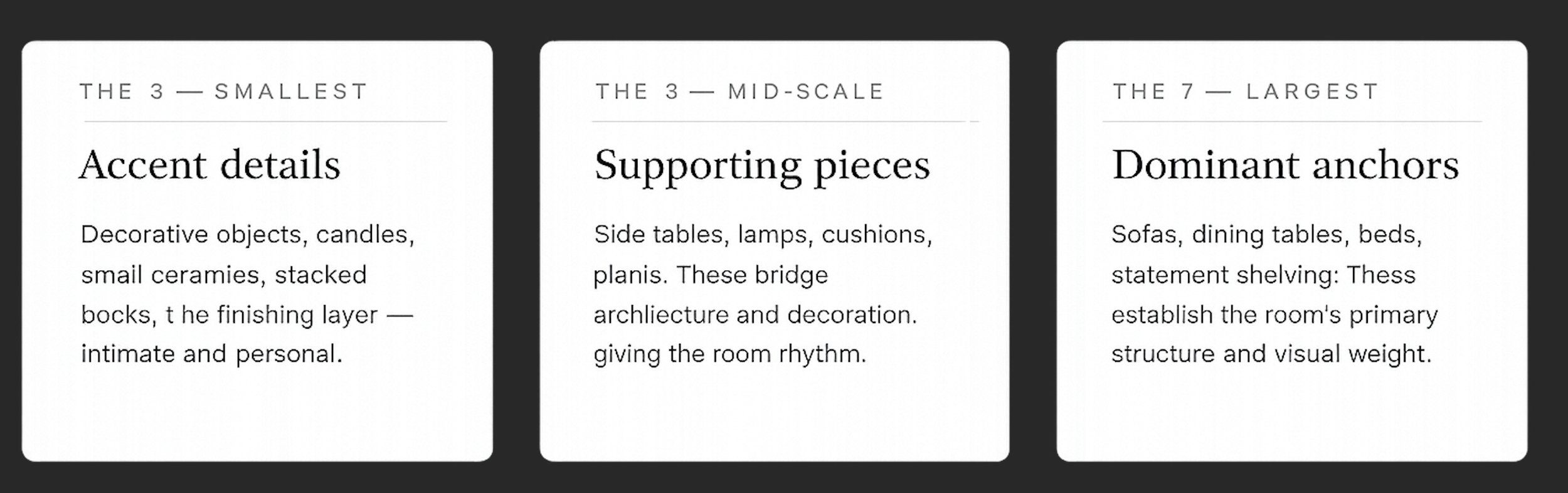
Why it works so well in London homes
London interiors tend to work with constraint, period features that demand respect, rooms that need to feel generous despite modest footprints, light that arrives at an angle. In these conditions, the 3-5-7 rule does something particularly valuable: it creates a sense of abundance and intention without clutter.
A Victorian terrace sitting room with seven considered furniture and lighting pieces, five layering elements, and three carefully chosen decorative objects will always feel more composed than one that's been filled instinctively or symmetrically. The rule doesn't require more, it simply asks you to be deliberate about what you have.
In a London home, every object earns its place or it doesn't stay. The 3-5-7 rule makes that editing instinct structural.
How to apply it in your home
Room by room
-
01On a mantelpiece or sideboard, group decorative objects in threes. Vary the heights tall, mid, low, so the eye travels across rather than settling.
-
02For a sitting room, count your cushions. Five is almost always better than four or six, two fabrics, two colours, one pattern tends to hold together beautifully.
-
03When planning a room from scratch, count to seven before you stop. Sofa, armchair, coffee table, side table, floor lamp, rug, and one considered decorative piece is a complete room.
-
04In open-plan kitchens and dining spaces, increasingly common in London conversions, use groupings of three on worktops and surfaces to avoid the dressed-for-a-shoot feeling.
-
05If something feels wrong and you can't identify why, count your groupings. An even number almost always wants one more, or one less.
When to set the rule aside
There are rooms where symmetry is the point. A pair of reading chairs flanking a fireplace in a Kensington drawing room. Matching bedside tables in a bedroom designed around calm. These are deliberate choices, and they carry their own authority. The 3-5-7 rule isn't a law, it's a diagnostic. When a room feels unsettled and you're not sure why, it's the first thing to check.
The designers who use it best rarely think about it consciously anymore. It becomes part of how they see a space, an instinct for grouping, weight, and rhythm that guides every decision without announcing itself.
Good design doesn't show its working. The 3-5-7 rule is most powerful when nobody in the room knows it's there.
Designing a London home?
Studio Akiva works with residential clients across London and the UK. We'd love to hear about your project.