Midimalism: The Interior Design Movement That Finally Makes Sense for London Homes
Minimalism, taken seriously, is exhausting. It demands a level of daily discipline, every object returned to its designated place, every surface wiped clear before bed, that most people are unwilling or unable to sustain. It also has a coldness problem. Properly executed, it produces spaces that photograph magnificently and feel, in person, like very expensive waiting rooms.
Maximalism, at its extreme, tips into noise. The energy that makes a maximalist room vibrant can, with one object too many, become the energy that makes it impossible to relax in.
Midimalism is what happens when enough people decide, quietly but conclusively, that they are done with both.
What Midimalism Actually Means
The term sits between its two parents, minimalism and maximalism, and borrows selectively from each. Sitting between Scandinavian minimalism and expressive maximalism, midimalism prioritises calm spaces that still feel personal and inviting. Rather than stark whites and empty rooms, midimalist interiors favour softer palettes, an organic feel, and layered textures, with furniture and décor chosen thoughtfully: fewer pieces, but each with intention, artisanal craftsmanship and subtle imperfections.
In practice, a midimalist home has the following qualities:
It is calm without being cold. The palette is restrained, warm whites, earthy neutrals, natural timber, but it never tips into the clinical blankness of hard-core minimalism. There is always something for the eye to rest on with pleasure.
It is personal without being cluttered. There are objects in a midimalist home, art, books, plants, things acquired with genuine affection, but they have been edited. Each one is there because it earns its place, not because it was never removed.
It is layered without being busy. Texture is the midimalist's primary tool: a linen sofa, a wool rug, a timber shelf, a ceramic bowl. The layers create warmth and visual interest without the chaos of pattern-on-pattern.
It ages well. This is perhaps the most important quality of all. Rather than over-styled spaces, midimalist homes come together more intuitively, guided by thoughtful and long-term choices that evolve naturally over time instead of being reset with every new trend cycle.
Why Midimalism Works Particularly Well in London
[IMAGE 1] Midjourney prompt: A London living room in midimalist style — warm white walls, original Victorian cornice, herringbone oak floor, a single curved linen sofa, round oak coffee table, one large framed botanical artwork, a fiddle leaf fig in a concrete pot, soft natural light from a sash window. Japandi-influenced, calm and considered. Architectural photography, wide angle, natural daylight. --ar 16:9 --style raw
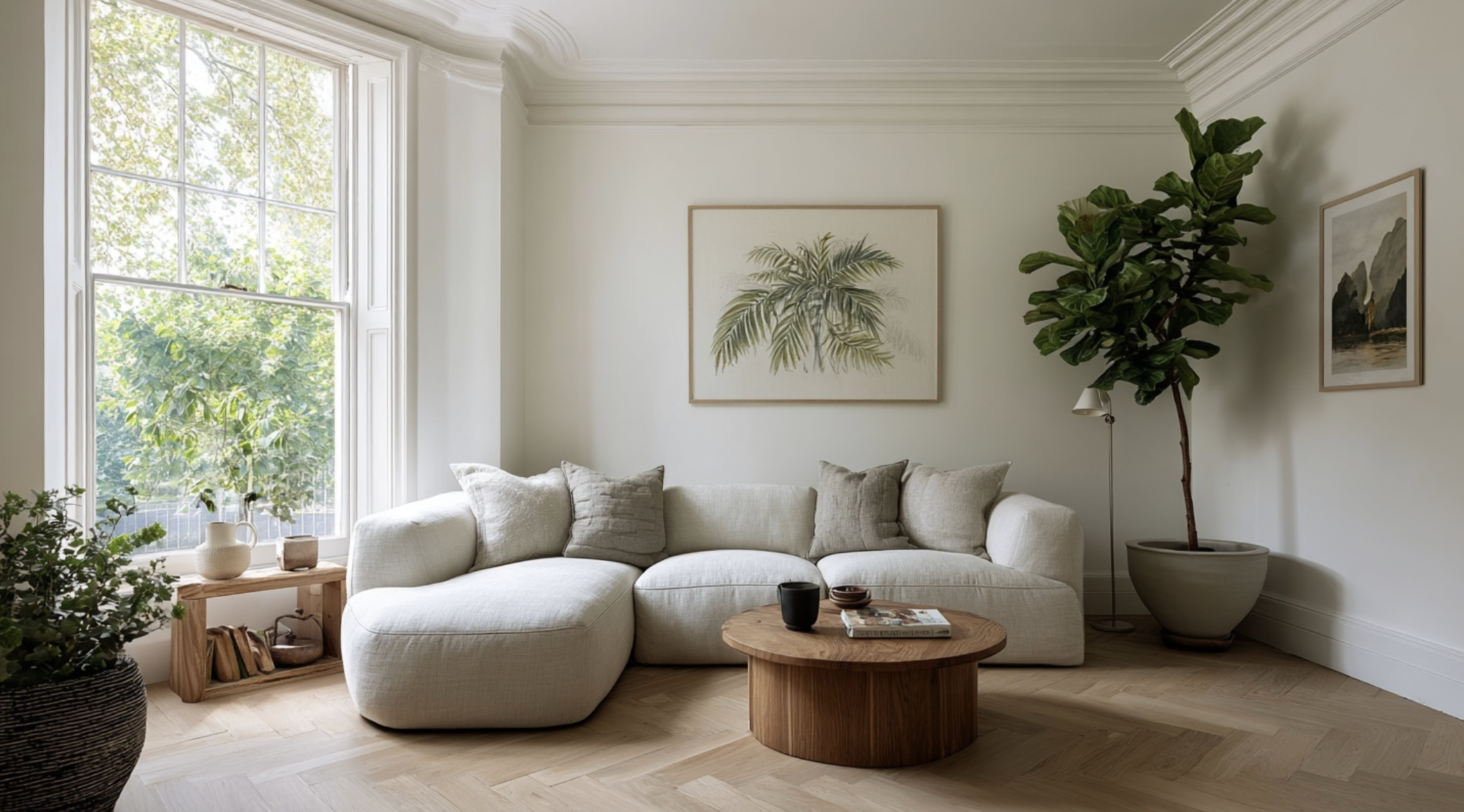
London's housing stock is unusually well-suited to midimalism, and it is worth understanding why.
The Victorian and Edwardian terraced houses that make up much of the capital's residential fabric already have the architectural features that midimalism celebrates: period cornices, original fireplaces, tall sash windows, generous ceiling heights, solid timber floorboards. These are not neutral backdrops. They are designed objects inherited, irreplaceable, and possessed of a warmth and character that no amount of flat-pack furniture can replicate.
Minimalism, applied to these buildings, tends to create a jarring disconnect: the warmth of the architecture set against the coldness of the interior. Maximalism overwhelms them, burying the features beneath layers of decor. Midimalism resolves the tension by treating the architecture as the hero, and then furnishing in its service.
The same logic applies to London's warehouse conversions, school conversions and period mansion flats. These are buildings with strong inherent character. They do not need a design aesthetic to impose personality on them. They need a design aesthetic to reveal it.
The Five Principles of a Midimalist Interior
1. Start With the Palette and Hold the Line
[IMAGE 2] Midjourney prompt: Midimalist bedroom interior in a London period flat — warm white walls, full-height oak slatted feature wall behind bed, white linen bedding, simple oak bedframe, matte black wall sconce, large sash window, soft afternoon light. No clutter, calm and warm. Architectural interiors photography, natural light. --ar 16:9 --style raw
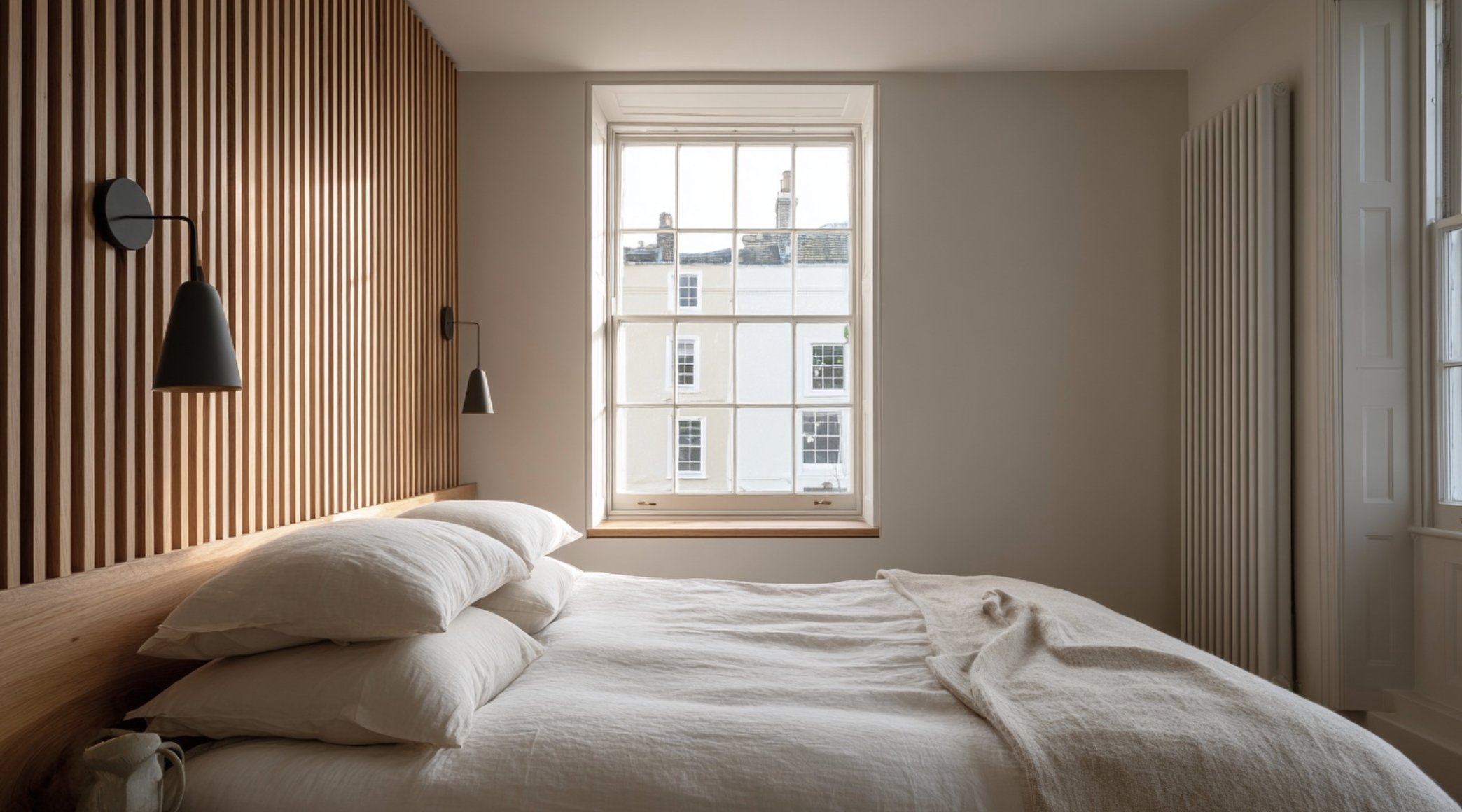
The midimalist palette is warm, not white. There is a meaningful difference. Pure white walls, especially the cool, blue-tinged whites that dominated British interiors for much of the 2010s — create an ambient coldness that no amount of textured furnishing can fully counteract. Pantone's 2026 Colour of the Year, Cloud Dancer, signals exactly this shift: a "billowy, balanced white" defined as a calming counterpoint, warm and welcoming rather than clinical.
The midimalist palette builds outward from warm white walls through natural timber, stone, linen and wool. Earthy neutrals, clay, sand, olive, rust, create warmth and depth, especially when paired with natural wood finishes, woven textiles and minimalist décor.
What it avoids: stark contrasts, cool greys, and the temptation to add a "pop of colour" that disrupts the calm the scheme is trying to establish. Colour in a midimalist interior is absorbed rather than announced, a terracotta cushion, an amber glass vase, a sage green plant pot.
Once you have the palette, hold the line. Every subsequent decision, furniture, fittings, art, accessories, should be tested against it. The single most common failure in midimalist interiors is a palette that gradually drifts: one purchase at a time, the coherence that defines the aesthetic is eroded.
2. Choose Fewer Pieces, But Choose Well
[IMAGE 3] Midjourney prompt: Midimalist dining room in a period London house — oak dining table, six upholstered linen chairs with oak legs, a simple brass chandelier, warm white walls, original cornice, wide plank oak floor, one large framed abstract artwork, natural light from tall sash windows. Calm, considered, editorial. Architectural photography. --ar 16:9 --style raw
Midimalism is not minimalism, but it shares minimalism's discipline about furniture quantity. The question is not "how much can I fit in this room?" but "what does this room actually need?"
A living room needs a sofa, a coffee table, a surface for a lamp, and somewhere to put a book. It does not need a three-piece suite, two side tables, a console, a TV unit and a blanket basket. The sofa should be of genuine quality, a piece chosen for its form, its material and its longevity rather than its price point. The coffee table should have character. The lamp should be beautiful.
Your home should tell your story, incorporating items that reflect your experiences and add character, rather than filling space for its own sake. In a midimalist interior, every object has been either inherited, discovered, or consciously acquired. Nothing is there by default.
This principle has a practical corollary: buy slowly. The midimalist home is assembled over time, not furnished in a weekend. The rooms that most consistently achieve the aesthetic are the ones where the owner has waited for the right piece rather than accepting the available one.
3. Use Texture as Your Primary Design Tool
[IMAGE 4] Midjourney prompt: Midimalist living room detail, a textured linen sofa in warm sand, a chunky knit throw, a round oak coffee table with a single ceramic bowl, a jute rug, soft shadows from afternoon light through a linen curtain. Close-up lifestyle photography, warm tones, no clutter. --ar 4:5 --style raw
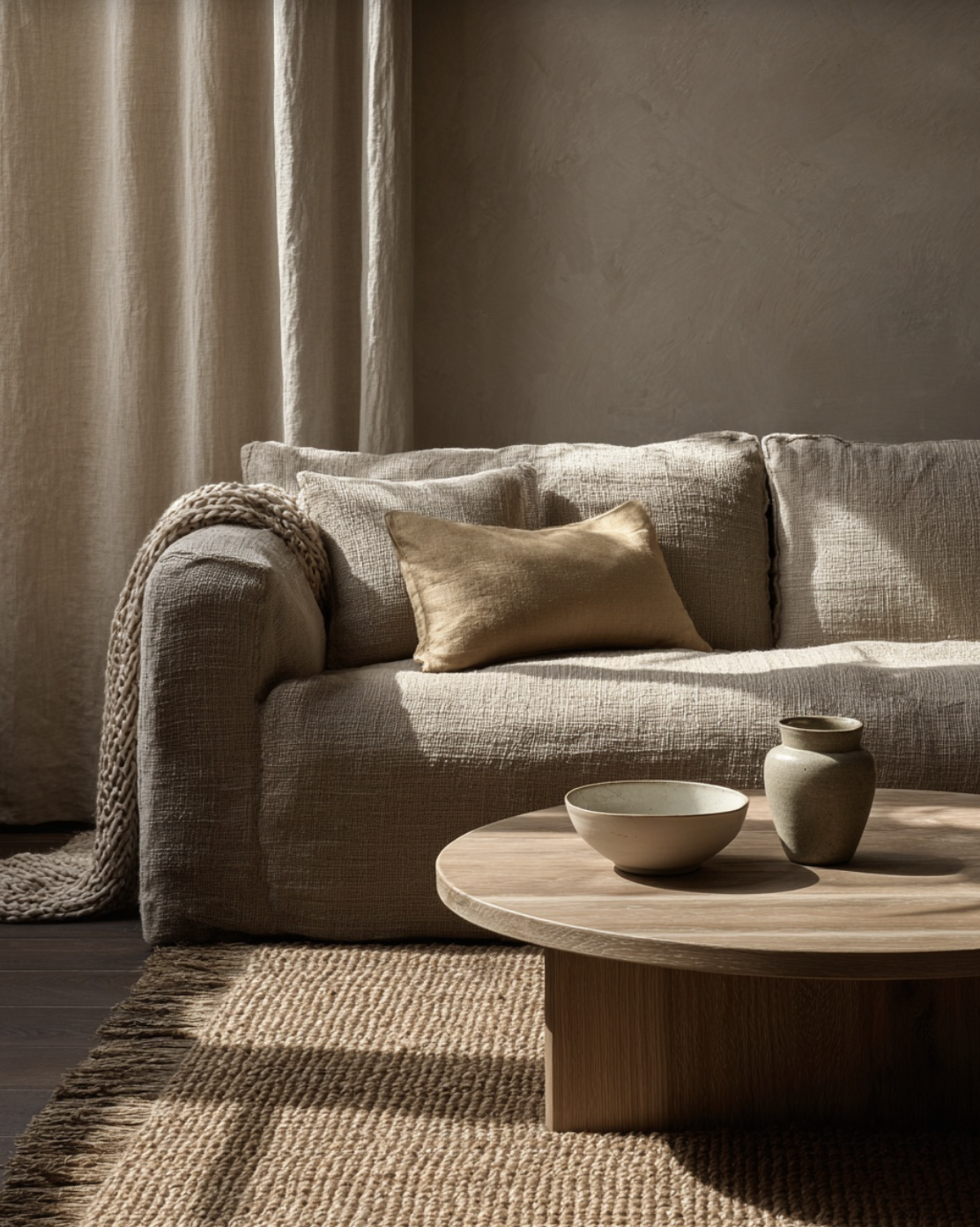
Where minimalism relies on emptiness to create visual calm, midimalism relies on texture. The two achieve similar results, a sense of quiet, of a room that does not demand attention, through entirely different means.
In a midimalist interior, the wall is warm white plaster or limewash. The floor is timber or stone. The sofa is linen or boucle. The rug is wool or jute. The cushions are a mix of weaves. The lamp base is ceramic. The shelf holds a stack of books, a plant, a single object of genuine meaning.
None of these individual decisions is dramatic. Assembled together, they produce a room of considerable sensory richness, one that feels warm and human in a way that a minimalist room, however beautiful, typically does not. Texture is playing a central role in 2026 home décor trends, with tactile materials defining the top choices for people redesigning or renovating their homes.
The practical instruction: when making any purchase decision for a midimalist room, ask first about material and texture before asking about colour or style. A linen sofa in the wrong shade will still feel right in a midimalist room. A velvet sofa in the perfect shade will feel slightly wrong.
4. Let the Architecture Speak
[IMAGE 5] Midjourney prompt: Midimalist open-plan living and dining room in a converted Victorian school or warehouse in London, exposed original steel beam painted dark, double-height white walls, herringbone oak floor, simple grey sectional sofa, round timber dining table, six linen chairs, original tall sash windows flooding the space with light. One large-scale artwork on the double-height wall. Wide angle architectural photography. --ar 16:9 --style raw
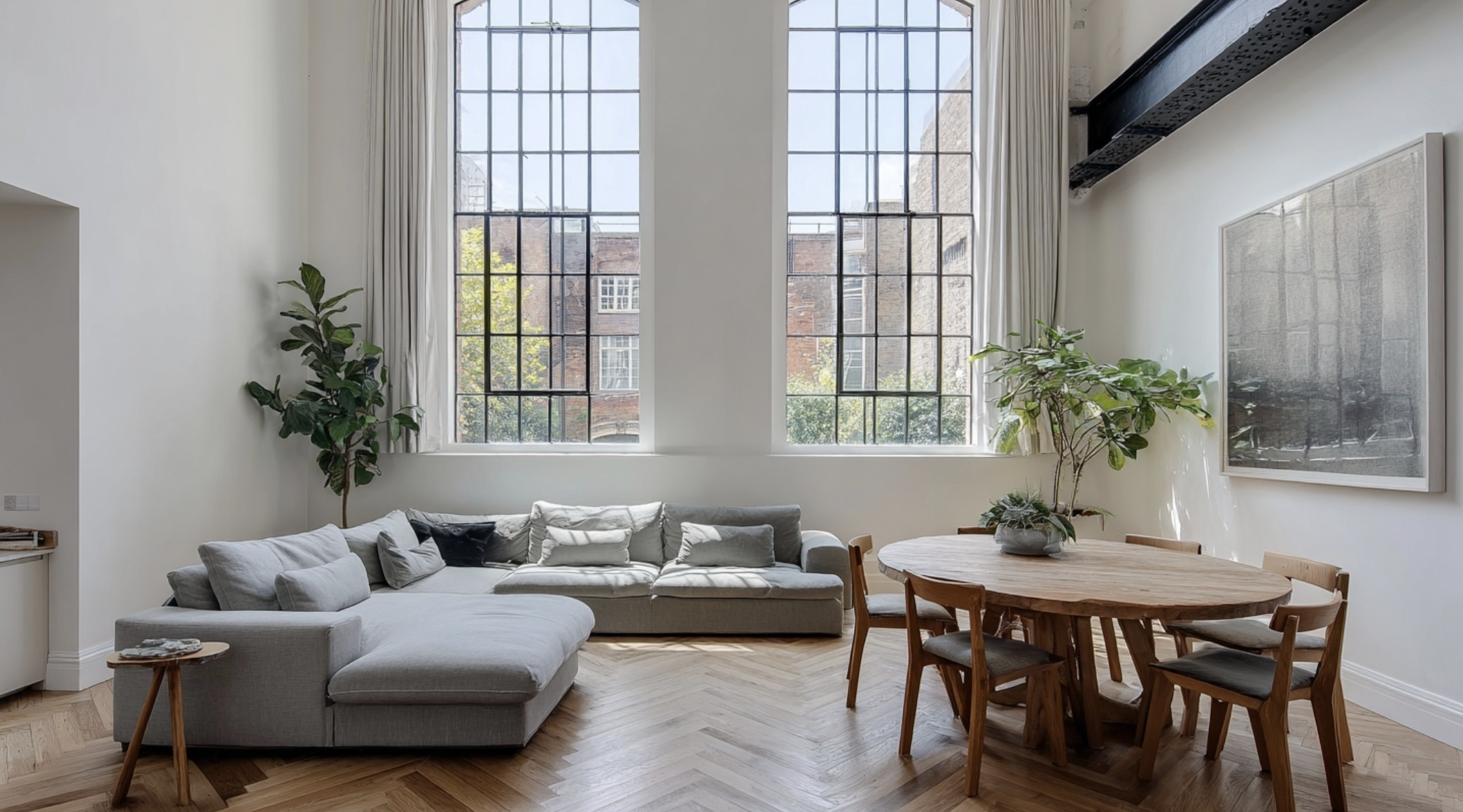
This principle applies with particular force in London, where so much of the housing stock has architectural features worth celebrating. An original Victorian fireplace, a period cornice, an exposed steel beam, a herringbone floor, these are the midimalist interior's best assets, and they are already there.
The instinct, in many renovations, is to either preserve heritage features in amber (keeping them exactly as found, surrounding them with period-appropriate furnishings) or to remove them in favour of a clean contemporary slate. Midimalism does neither. It treats heritage features as the contemporary interior's most valuable collaborators — warm, characterful, irreplaceable anchors around which the modern elements are arranged.
Practically, this means: paint the cast iron radiators dark rather than hiding them. Leave the cornices intact and paint them the same warm white as the walls rather than picking them out. Lay herringbone timber rather than straight-laid boards. Hang one large-scale artwork at the correct height for the room's volume rather than clustering small frames at eye level.
The architecture should do the heavy lifting. The design's job is to let it.
5. Edit Ruthlessly, Continuously
[IMAGE 6] Midjourney prompt: A beautifully edited midimalist bookshelf in a London home — warm oak shelving with a curated selection of books, two ceramic vessels, one trailing plant, one framed print leaning against the back. Soft natural light. Nothing excess. Close-up lifestyle photography, warm neutral tones. --ar 4:5 --style raw
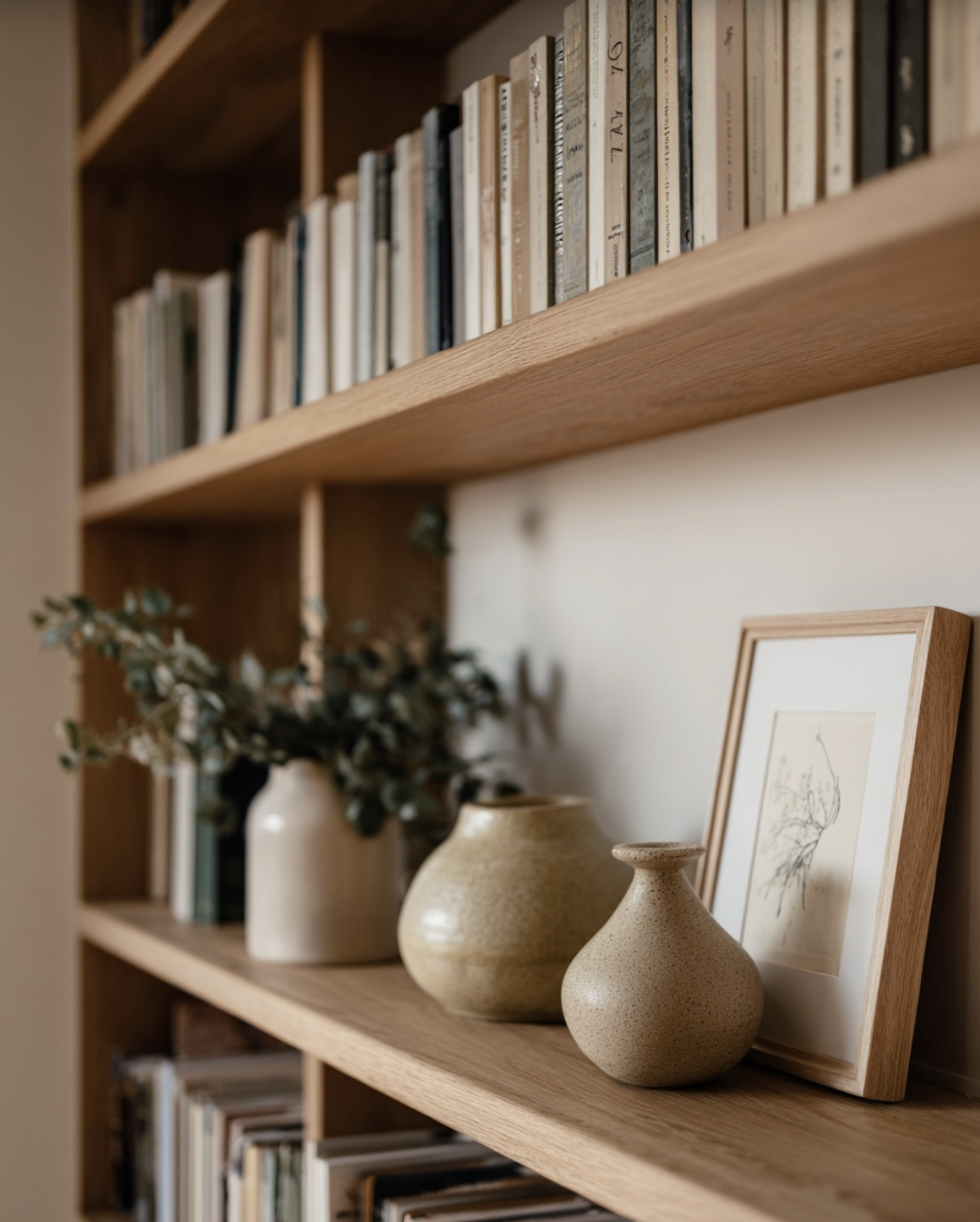
The midimalist home is not a one-time project. It is an ongoing practice of editing and this is, for most people, the hardest part.
Objects accumulate. Gifts arrive. Purchases that seemed right at the time reveal themselves, over months of living with them, to be slightly wrong. Children happen. The midimalist home requires its occupants to periodically review what is there and make decisions about what stays.
The test is simple: does this object earn its place? Does it have genuine meaning, genuine beauty, or genuine function? If not, or if it once did and no longer does, it should go.
This is not the austere, joyless editing of hard minimalism. It is closer to the Japanese concept of ma, the value of negative space, of what is deliberately absent. In a midimalist room, the empty surface is not evidence of incompleteness. It is a design decision. It is what allows the objects that remain to be properly seen.
The Midimalist Home: Room by Room
Living Room
[IMAGE 7] Midjourney prompt: Midimalist London living room — warm white walls, original Victorian fireplace with simple white mantel, large round brass-framed mirror above, curved sage green velvet sofa, round oak coffee table, wool rug in warm oatmeal, one fiddle leaf fig, one large framed artwork. Herringbone oak floor. Calm, warm, personal. Wide angle architectural photography, natural light. --ar 16:9 --style raw
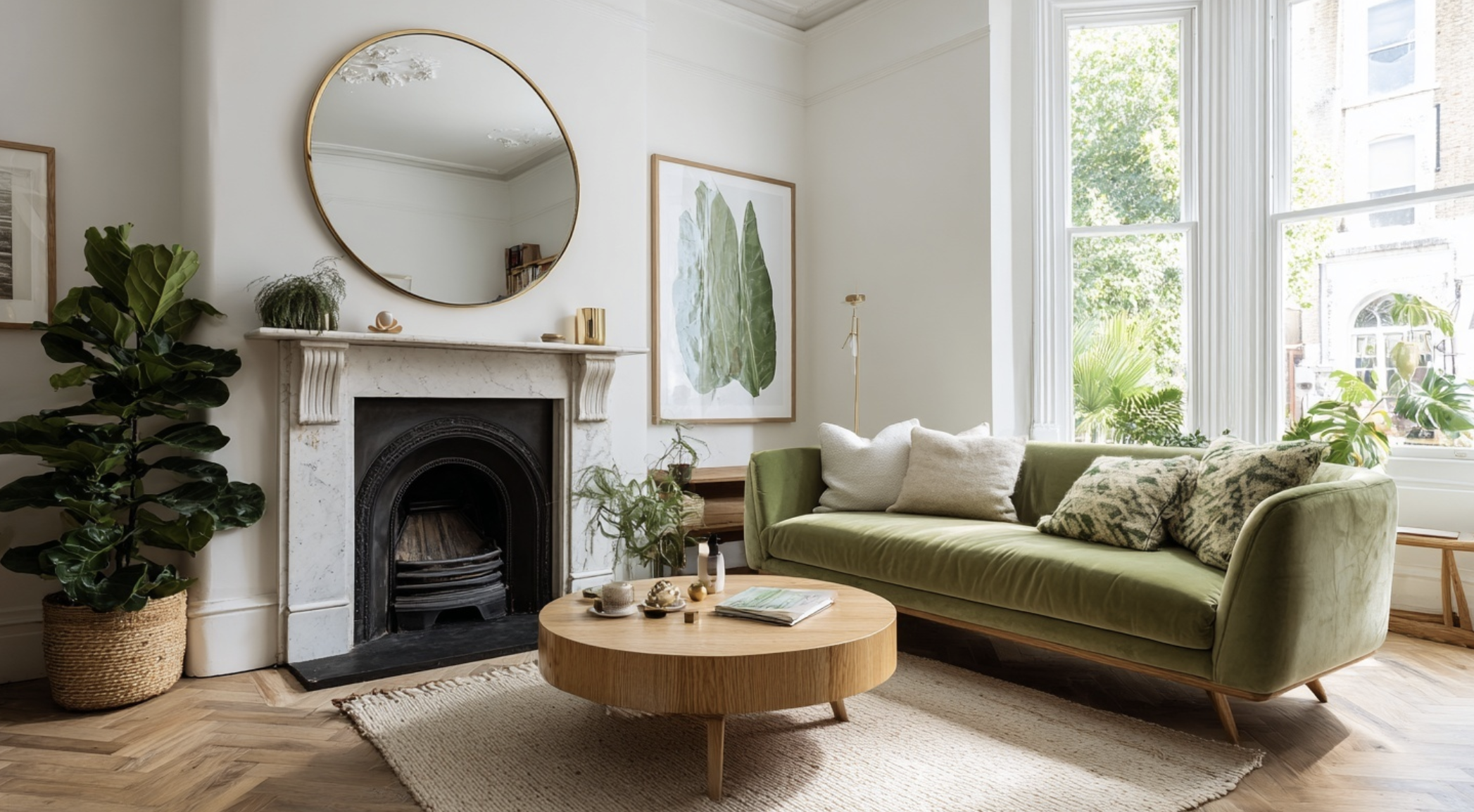
The midimalist living room begins with its anchor, in a period London home, usually the fireplace; in a warehouse conversion, usually the structural feature that defines the space. Furniture is arranged in relation to that anchor, not pushed against the walls.
The sofa should be one piece of genuine quality rather than a three-piece suite. Curved forms, a kidney-shaped sofa, a round coffee table, work particularly well in midimalist schemes because they soften the geometry of the room without introducing pattern or colour.
Art is not optional. A midimalist living room without art tends to feel unfinished, as though something is being withheld. The art should be large enough to hold the wall it's on, and personal enough to mean something.
Kitchen
[IMAGE 8] Midjourney prompt: Midimalist kitchen in a London period home — warm oak shaker cabinets with simple brass cup handles, white Calacatta quartz worktop, white painted walls, original sash window above the sink, matte black tap, open shelving with ceramic vessels and a few cookbooks, herringbone oak floor. Calm, warm, functional. Architectural photography, natural light. --ar 16:9 --style raw
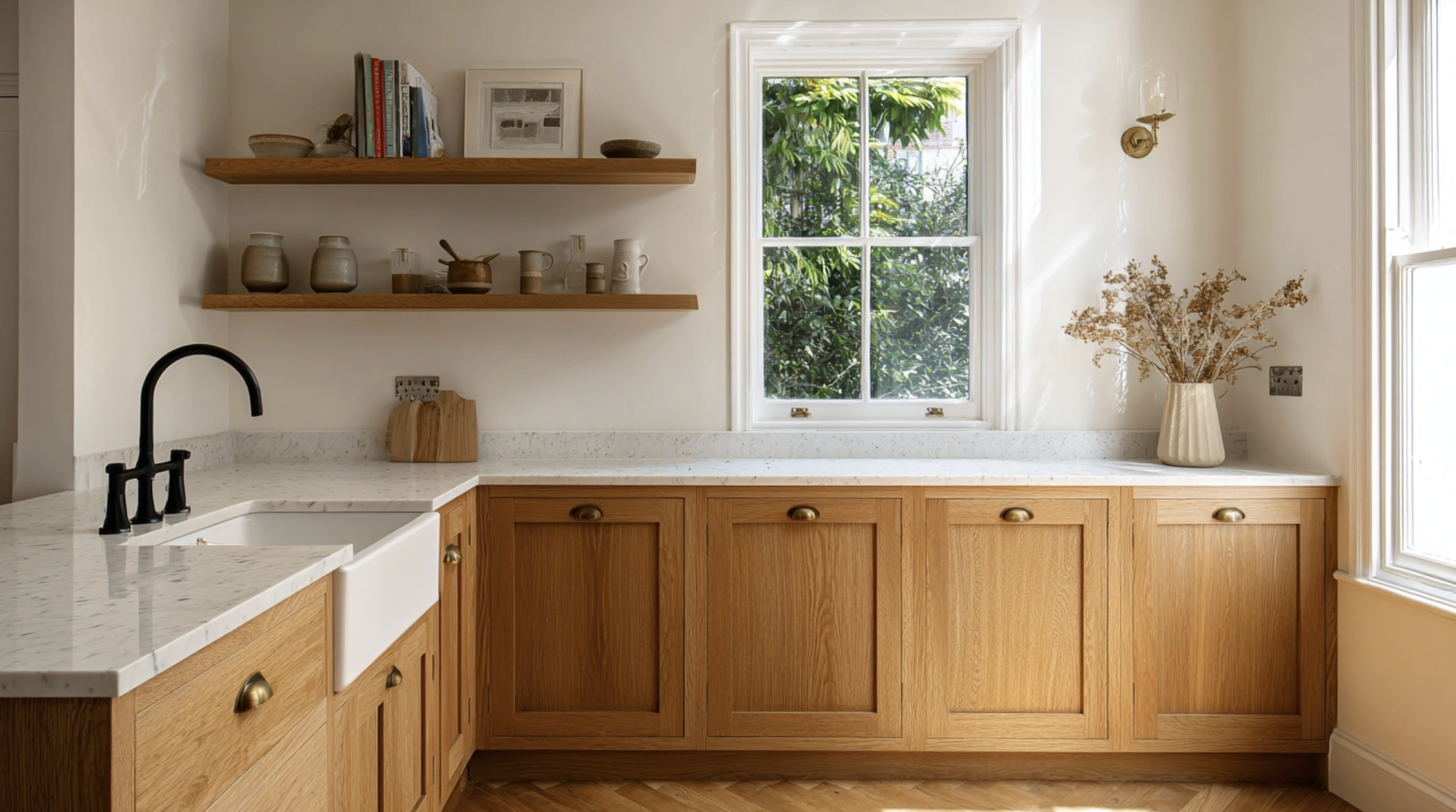
The midimalist kitchen avoids both the all-white handleless kitchen of strict minimalism and the pattern-heavy, colour-saturated kitchen of maximalism. Warm timber cabinetry, shaker or flat-front, with simple hardware in brass or matte black sits against white walls and a light stone worktop.
Open shelving, used sparingly, provides the opportunity for the kind of considered display, a few good ceramics, a stack of cookbooks, a plant, that gives the kitchen its personality. The discipline is in not overfilling those shelves. Two ceramics and a plant is midimalism. Eight ceramics, six plants and a collection of vintage tins is maximalism with good intentions.
Bedroom
The midimalist bedroom has one non-negotiable: it must be a place of genuine rest. This means no screens unless completely concealed, no exercise equipment, no work materials. The objects in the room should earn their place specifically by contributing to sleep and recovery.
A full-height timber feature wall behind the bed, oak slats, limewash panelling, or simply a deep warm paint, provides the textural warmth that a headboard alone cannot. White linen bedding. Simple timber nightstands. A single reading lamp with a warm bulb. A plant. Nothing else that isn't genuinely necessary.
What Midimalism Is Not
It is not minimalism with soft furnishings. Adding a boucle throw to a stark white room does not produce a midimalist room. It produces a stark white room with a boucle throw.
It is not maximalism with restraint. Editing a cluttered room down to its best pieces moves in the right direction, but midimalism is built from the beginning with intention, not arrived at by subtraction.
It is not a trend. The most important interior design shift of 2026 is the move away from fast interiors altogether, towards spaces that feel warmer, more balanced and comfortably imperfect, and that evolve naturally over time instead of being reset with every new trend cycle. Midimalism is, in this sense, the antithesis of trend-led design. It is slower, more personal, and considerably more durable.
Is Your Home Ready for Midimalism?
The good news is that most London homes are already halfway there. The architecture is doing its part. What most homes need is not more, more furniture, more colour, more objects, but less, chosen better, arranged with more confidence.
If you are planning a renovation and want to create a home that achieves the calm, personal, textural warmth that midimalism promises, the place to start is with a designer who understands both the principle and its application in the specific context of your home and its architecture.
Studio Akiva designs residential interiors across London that are warm, considered and built to last, the antithesis of the trend-chasing approach that midimalism, by its very nature, rejects. If that sounds like the home you want, start the conversation here.
Explore our residential interior design services or browse our project portfolio for examples of midimalism applied in real London homes.