 Image 1 of 2
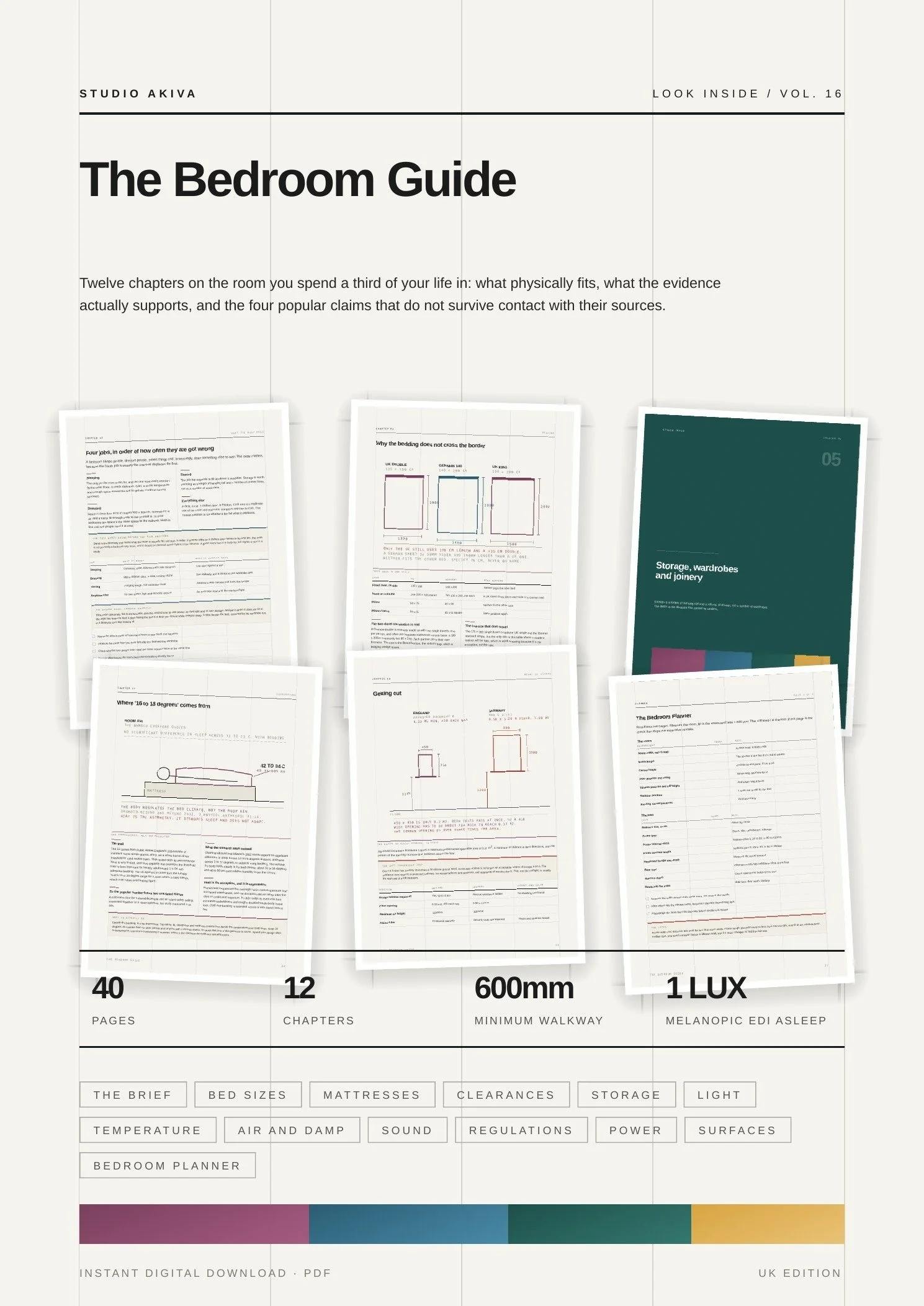 Image 2 of 2
The Bedroom
Guide
Twelve chapters on what physically fits, what the evidence supports, and four popular claims that do not survive their own sources.
See the twelve chaptersA bedroom is the easiest room
to furnish and the hardest
to get right.
Most rooms announce their failures. A bedroom hides them: one side of the bed is too tight to walk down, the wardrobe door fouls the frame, the window is on the wrong wall for the morning. This guide is about the decisions underneath the decoration, in the order the room gets built.
Plan around the bed
The bed is the largest object in the room and needs clear space on three sides. Clearances, frame allowances and a one-line arithmetic check you can do before you buy anything.
Specify in centimetres
Bed sizes are trade convention, not standards. A German double is 50mm wider and 100mm longer than a UK one, and "king" means three different things.
Four environments, not one
Light, temperature, air and damp, and sound. They are decided by the window, the wall and the door, which is why a blind bought at the end cannot rescue them.
Know the rules that apply
Escape openings, smoke alarms, sockets and ventilation, with the figures from Approved Documents B, F, M and O and where each one stops applying.
Twelve chapters, in the order
the room gets built.
Chapters 02 to 05 are the ones to read before you spend anything. Chapters 06 to 09 are the ones people skip and then regret. Chapter 10 is the one to read before you move a window or a wall.
What the room actually has to do
Four jobs, in order of how often they are got wrong, and a test to run in the doorway before you plan anything.
Bed sizes and the cross-border trap
The UK sizes in centimetres and imperial, mattress depths, and why bedding bought in one country does not fit a bed bought in another.
Choosing a mattress
What the one good randomised trial found, what it did not, the seven-year rule traced to its source, and what a mattress costs.
Planning the room around the bed
Walkways, the foot of the bed, frame allowances and which wall the bed goes on, with a worked example.
Storage, wardrobes and joinery
Why 600mm is the only depth that hangs a jacket square, hanging zones, and fitted costs where two UK sources disagree.
Light
The melatonin numbers that have changed by an order of magnitude, three circuits instead of one, and where the standards stop.
Temperature and the bed microclimate
Where "16 to 18 degrees" comes from, what the thermoregulation research says instead, and why heat is the one to design against.
Air, humidity and damp
Why the wall is colder than the room, what the CO2 research does and does not show, Approved Document F, and Awaab's Law.
Sound
The 40 dB figure that is really an outdoor measurement, the number worth knowing instead, and the cheapest real improvement.
Safety and the regulations
Escape windows, smoke alarms, minimum sizes, daylight, and mattress and bedding fire performance, set against Germany, France and Spain.
Power, switching and controls
What goes where, what no UK rule actually specifies, and the list to run at first fix while the walls are open.
Surfaces, textiles and the finished room
The last ten per cent, kept short on purpose: acoustics, dust, and a room that has to read at two light levels.
The Bedroom Planner
Two printable pages. Measure the room, fill in the boxes and take it with you. The arithmetic at the foot of the first page is the check that stops the expensive mistake.
Where popular bedroom advice
runs past the research.
Every figure in the guide carries a named standard or a named piece of research. Where a claim is popular but unsupported, it is corrected rather than repeated, and you get the figure that does hold up.
| "16 to 18 degrees is the ideal bedroom temperature" | No study measured it. Sleep did not differ across 13 to 23 degrees with bedding. The 18 comes from a cold-harm threshold for vulnerable people and the 16 from an infant guide. Chapter 07. |
| "About 100 lux affects melatonin" | Individual thresholds ran from 3.1 to 181 melanopic lux, a fifty-fold spread with a median around 14. It is not safe as design guidance. Chapter 06. |
| "The WHO says 40 dB in the bedroom" | It is an outdoor figure measured at the facade. The WHO assumes 21 dB of attenuation, so 40 outside is roughly 19 inside. Chapter 09. |
| "Replace your mattress every seven years" | It comes from an industry trade body and cites no study. Replace on observed condition, not on a birthday. Chapter 03. |
What format is it?
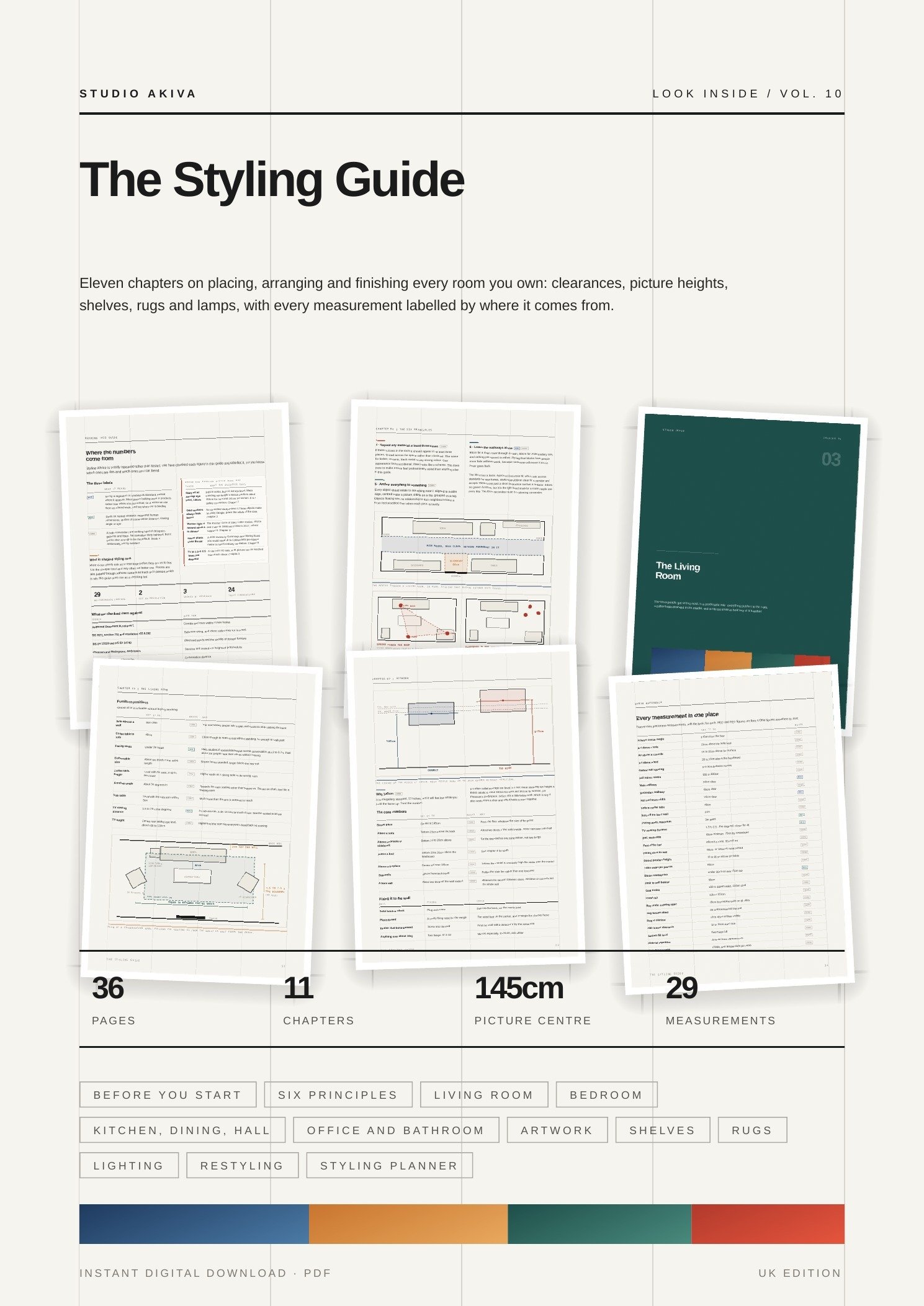
A 40-page A4 PDF with twelve chapters, eight measured drawings and a two-page printable planner. It is an instant download after purchase, and the planner pages are built to be printed and taken to the showroom.
Which edition is this?
This is the UK edition. It uses UK sizes and names the Approved Documents and British Standards that apply in England. There is a separate EU edition, because bed sizes, smoke alarm duties, escape openings, socket counts, daylight and mattress fire rules all differ across the Channel, and swapping the currency would have produced a guide that is wrong on the facts.
Do I need to be renovating?
No. Most of it applies to any bedroom, whether you are furnishing one or changing it. Chapters 02 to 05 matter most before you buy, chapters 06 to 09 for any bedroom that is not working, and chapter 10 before you touch a window or a wall.
Is it legal or building advice?
No. We are interior designers, not fire engineers, building control officers or lawyers. The figures are the published guidance as we read it in September 2026. On any job that moves a window, adds a storey or changes what a room is used for, take advice from a building control body or an approved inspector before you commit.
What if a figure has moved?
Sources are named at the point each figure is used, and where two reputable sources disagree the guide shows you both. If you find something that has moved on, tell us and we will correct it in the next edition.
If you would rather someone else
planned the bedroom.
Studio Akiva is an award-winning London interior design studio and a twelve-time Houzz award winner. We plan bedrooms as part of whole-house and single-room projects, residential and commercial, with a designer matched to the job. The discovery call is free, and nothing is attached to it.
Book a discovery call