 Image 1 of 2
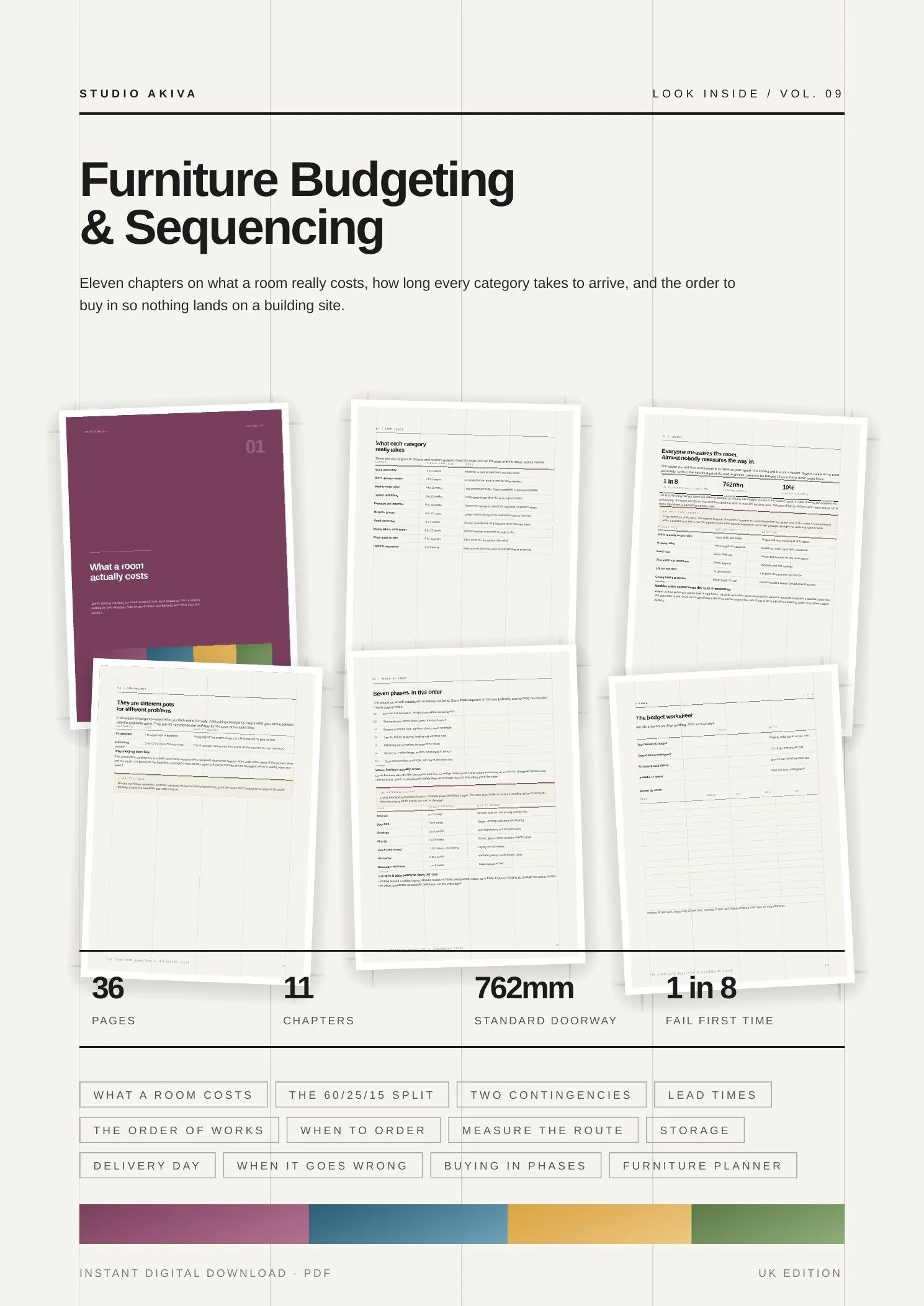 Image 2 of 2
Most furniture mistakes are timing mistakes, and almost all of them are preventable on paper.
The piece was right.
The room was right.
What went wrong was when it was ordered, or what was left in the budget by the time it came to buy it. A sofa quoted at ten weeks and ordered in week eight, a contingency spent on the building work months before the furniture needed it, a three seater that fits the room perfectly and cannot get past the hall. None of those are failures of taste, which is the quiet good news, because every one of them can be fixed before you spend anything.
Lead times UK makers publish
One to two weeks for stock upholstery, four to twelve for a made to order sofa, eight to sixteen for premium and imported, and the July and August factory shutdowns nobody mentions when quoting a date.
Doorways measured properly
A two foot six door leaves about 686mm of clear passage and a two foot nine about 762mm. Almost none of them will pass a three seater lying flat, which is why the route matters as much as the room.
Honest where the data is thin
Carriers reported 92.9 per cent first attempt success in the second quarter of 2025, roughly one in fourteen failing. That is a parcel figure, not a furniture one, so we treat it as the best case and say so.
Two worksheets, not a reading list
A budget sheet that holds both contingencies separately, and an ordering sheet with a column for the two dates that decide everything: needed by, and order by.
- 01What a Room Actually CostsThe share of property value rule, why it breaks down between a London flat and a house in the north, and which rooms take the money.
- 02The Sixty, Twenty-Five, Fifteen SplitWhy spreading a budget evenly feels fair and produces a room that reads as unfinished.
- 03Two Contingencies, Not OneSeven to ten per cent on the build, ten to fifteen on the furniture, and why merging them leaves you empty at the wrong moment.
- 04Lead Times, Category by CategoryTen categories with the ranges UK makers publish, and how to read a quoted date honestly.
- 05The Order of WorksThe seven phases that do not bend, and the two separate moments furniture actually enters.
- 06When to Order Against the ProgrammeWorking backwards from the date you need it, and why decorative lighting has the earliest deadline in the list.
- 07Measure the Route, Not Just the RoomBritish doorways as clear passage rather than leaf width, hallways and turns, the diagonal, and the ten per cent rule.
- 08Storage, and the Cost of Arriving EarlyGuarantees that start at delivery, inspection windows measured in days, and what a freshly plastered house does to solid timber.
- 09Delivery DayThe half hour that decides whether a problem is the carrier’s or yours, and what to write on the docket.
- 10When Something Goes WrongRestocking charges that are not always enforceable, the Consumer Contracts Regulations 2013 and the Consumer Rights Act 2015.
- 11Buying in PhasesThe order to buy rooms in, why living with the anchors changes what you buy next, and the one thing never to phase.
Plus a quick reference page with every figure in the guide, and two printable worksheets: the budget and the ordering schedule.
What format is it?
A 36-page A4 PDF. Your download link arrives by email straight after checkout, and you can read it on any device or print it at home.
Which edition is this?
UK. Door widths are British imperial sizes measured as clear passage, lead times are the ranges UK makers and retailers publish, VAT is the standard 20 per cent, and the consumer rights chapter is written around the Consumer Contracts Regulations 2013 and the Consumer Rights Act 2015. Prices in the worked examples are in pounds.
Why do the door measurements matter so much?
Because the number on the door is not the number you can carry a sofa through. Hinges and stops take 30 to 40mm, so a two foot six door gives about 686mm and a two foot nine about 762mm. A three seater is commonly 900mm deep, so it has to go through on its side, and the height of the opening and the diagonal at every turn matter as much as the width. Chapter 7 sets out what to measure and gives you a ten per cent rule to work to.
Is it useful if I am not renovating?
Yes. Chapters 1 to 3 on budget and contingency, and 7 to 11 on access, delivery and phasing, apply to furnishing any home. Chapters 5 and 6 are the ones written around building work.
Do I need it if I have hired an interior designer?
Probably not for the sequencing, which is what you are paying them for. It is still useful for understanding why the programme looks the way it does, and the access chapter is worth reading before you fall in love with a sofa.
Can I get a refund?
This is digital content supplied immediately. At checkout you agree to the download starting straight away and acknowledge that this ends the usual 14 day cancellation right. Separately from that: if the link fails, the file will not open, or you received the wrong guide, email hello@studioakiva.com and we will put it right or refund you.
Would you rather we did it?
Studio Akiva is an award-winning London interior design studio and a twelve-time Houzz award winner. Our team plans furnishing budgets, programmes orders around a building schedule and manages delivery for clients across the United Kingdom, and passes trade discounts on in full. If you would rather talk it through before you commit, book a free fifteen-minute discovery call.